
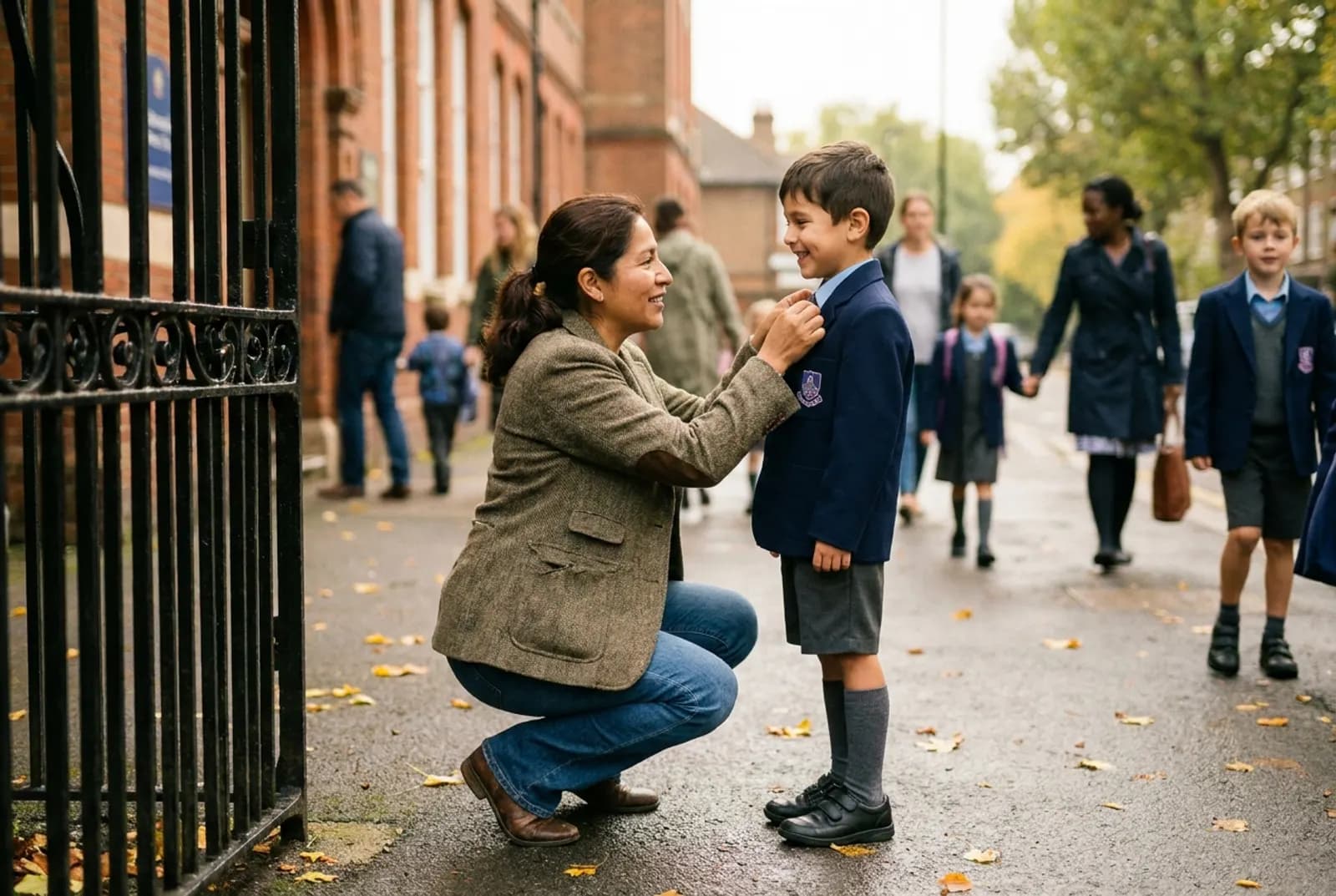
The basics: free, compulsory and no papers
State school in England is free and compulsory from 5 to 16 (and until 18 you must stay in education or training). They start earlier: Reception is for 4-year-olds — children born between 1 September 2021 and 31 August 2022 start in September 2026.
And the thing that reassures newcomers most: your child's place doesn't depend on your immigration status. Every child living in England has the right to go to school, and the school is not the immigration office.
Official links: School starting age (GOV.UK) · Summer-born children: when to start (GOV.UK)
How to apply for a place (the two doors)
You do NOT apply at the school: you apply to your council, which coordinates all the state schools in the area. There are two routes depending on when you arrive:
- You arrive mid-year or have just moved → an 'in-year' application. Go to your council's website, search 'in-year school application', list 3–6 schools in order of preference and they offer a place where there's a vacancy. It's processed in order received: don't leave it for later.
- Your child starts Reception (age 4) or secondary (Year 7, age 11) next September → the 'main round': primary by 15 January and secondary by 31 October of the previous school year. Miss the deadline and you can still apply, with fewer options.
- London councils share one system: you apply to yours even if you prefer a school in the neighbouring council.
- If there's no place at any nearby school, the council must find your child one (there's a protocol for it). Insist in writing.
Official links: How to apply for a school place (GOV.UK) · Find your council
How to choose a school without losing your mind
Three things really matter: distance (most schools prioritise children who live close — the 'catchment'), the Ofsted report (the official inspector: every school has a public one) and how it feels when you visit. Call and ask for a visit: it's normal, and it tells you more than any website.
- Search schools by postcode on the official finder and read their Ofsted report.
- Ask how they support children arriving with no English (EAL — English as an Additional Language). All state schools must support them; the good ones explain how.
- Faith schools (Catholic, Church of England…) are also state-funded and free, with their own admission criteria; many Latin American families choose them.
Official links: Official school finder (GOV.UK) · Ofsted reports
Money: what's free and what you pay for
Lunches: meals are free for every child in Reception, Year 1 and Year 2; from the 2026/27 school year, also for any family on Universal Credit, regardless of income. You must APPLY to the council — it isn't automatic, and it also brings the school extra funding for every child registered.
Before school: 15 or 30 hours a week of free childcare for 3- and 4-year-olds (and some 2-year-olds), depending on your work situation. Uniform is paid by the family; some councils and schools offer help or second-hand uniform — ask without embarrassment, it's common.
Official links: Apply for free school meals (GOV.UK) · Free childcare for 2- to 4-year-olds (GOV.UK)
What nobody tells you until it happens
- Attendance is taken seriously: unauthorised absence (including holidays in term time) can end in a fine for parents. Long trips home are planned in the school holidays, which each council publishes a year ahead.
- You have the right to an interpreter at school meetings: ask. And most schools use an app for notices and payments — get it set up on day one.
- If your child changes school mid-year, the records transfer automatically. If they need special support (SEN), ask the school in writing: there is a process and it doesn't depend on your papers.
Official links: School attendance and absence (GOV.UK)
Frequently asked questions
Can they ask for immigration papers to enrol my child?
No. School enrolment doesn't depend on the family's immigration status and schools don't check it. They'll ask for proof of address and the child's date of birth to allocate a place.
My child speaks no English at all. Will they accept them?
Yes. State schools must support pupils learning English (EAL). Children pick it up fast; ask the school what support they give in the first weeks.
How long does an in-year place take?
It depends on vacancies: from days to several weeks. Apply as soon as you have an address and list several schools; if there's none nearby, the council must find one.
What if I don't like the school I'm given?
You can accept the place (so your child doesn't miss school) and stay on the waiting list for the one you prefer, or appeal the decision in writing. The council explains the appeal process in the offer letter.